Proficiency
During my Student Teaching Semester (Jan-Apr 2024), I developed proficiency in eliciting and interpreting student thinking (EIST). Specifically, my ability to prepare questions to elicit, follow student thinking, interact with students and interpret their thinking is becoming effective.
“Participation is the best I’ve seen so far for you- the changes in your eliciting strategies are paying off.” – OU Supervisor
NGSS Standard:
- HS-LS1-1. Construct an explanation based on evidence for how the structure of DNA determines the structure of proteins, which carry out the essential functions of life through systems of specialized cells.
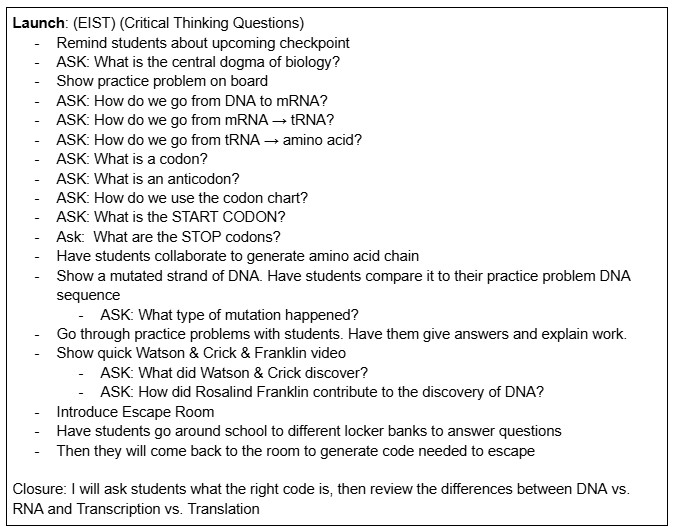
- Preparation: Questions were clear, exploring most of the core ideas of the content (see above). I thought about what to ask ahead of time and anticipated student responses.
- Following Student Thinking: I made several attempts to follow student reasoning, going “off script” and exploring unique student ideas even if they seemed different than the assumed “right” idea. I made sure to take in every student contribution in some way to help foster the “no wrong answer” community I aim to create. Probing questions were mostly open-ended.
- Interactions with Students: I positively interacted with students, listening to them and establishing connections with them during the semester to better understand their interests, abilities, and thought process. I revoiced student responses using repetition as a tool to clarify content and make sure everyone heard.
- Interpreting Student Thinking: While teaching, I described features of student understanding aloud and made conclusions about student understanding tied to specific responses from the student. When they weren’t clearly understanding a concept, I modeled a problem for the class that the students helped me work through.
Listed below are talk strategies I used to help facilitate a productive group discussion about the content:
- Asking the class, “does anyone have anything to add to that?” after getting a student response
- Following up on answers with “but what else do we need to consider?” to get students thinking deeper
- Asking, “how do you know that?” when students provide a valid response that could be further explored
- Revoicing what students said
- ex. “Okay, so what I heard her say was…”
- Asking the class, “Do we agree with that? Disagree? Why?”
“Your eliciting is so much stronger! You are getting more volunteers and variety in responses, and responding with a bigger toolkit for following up on their thinking.” – OU Supervisor