Growth Case
During my Final Field (Sep-Dec 2024), I made one real attempt at leading a group discussion with OU Supervisor observing me teach. I taught a lesson on Urchin Anatomy to my 9th/10th biology classes using modified content based on the phenomenon-driven Storyline on Homeostasis, developed by All Species Consulting (see slides below).
NGSS Standard:
- HS-LS2-6. Evaluate claims, evidence, and reasoning that the complex interactions in ecosystems maintain relatively consistent numbers and types of organisms in stable conditions, but changing conditions may result in a new ecosystem.
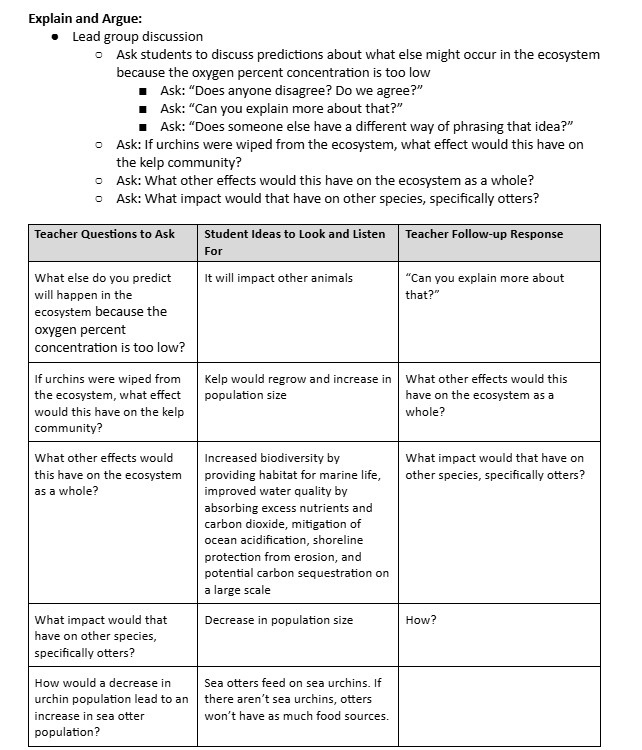
Despite planning questions to elicit student thinking ahead of time (left), feedback from my OU supervisor showed that a group discussion was “not observed” and “there was a missed opportunity for this”. At this point in the semester, I lacked confidence in my ability to lead the classroom and didn’t have the chance to establish solid relationships with my students. I couldn’t be myself which made it difficult to interact naturally.
“You ask a question about dead zones. Crickets. You answer your own question.” – OU Supervisor
Reflecting on that teaching experience, I now have learned and practiced strategies to combat the awkwardness that arises from absolute silence in response to a question intended for group discussion (ex. turn-and-talk).
During my Student Teaching Semester (Jan-Apr 2024), I used modified content from the Disease Storyline to teach a lesson on DNA Structure (see slides below).
NGSS Standard:
- HS-LS3-1. Students will be able to ask questions to clarify relationships about the role of DNA and chromosomes in coding the instructions for characteristic traits passed from parents to offspring
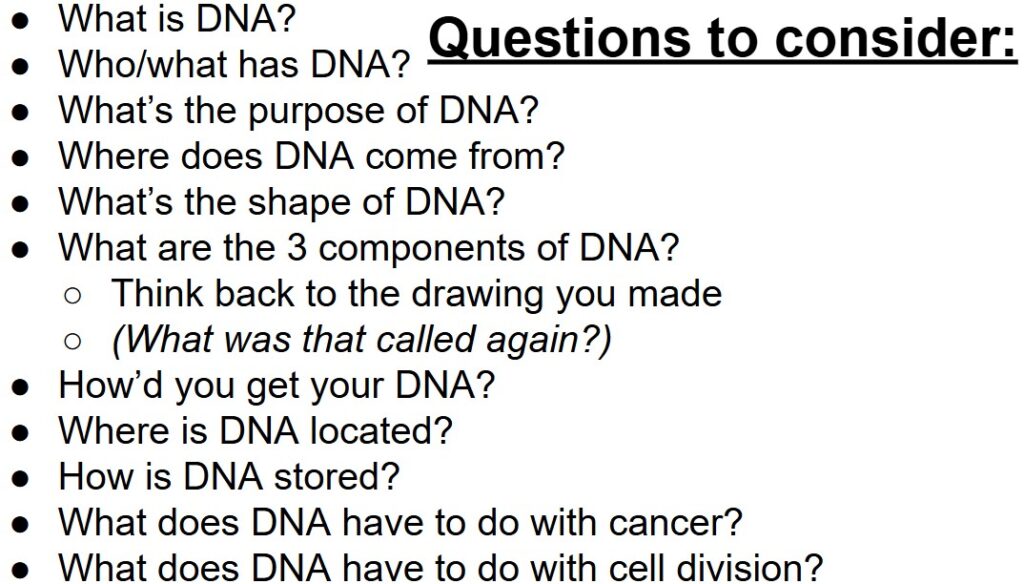
- First, I had students collaborate to create a concept map “brain dump” style using their prior knowledge of the structure of DNA (see below, left).
- Then, we created a class consensus map on the board using unique ideas from each group.
- After that, we had a group discussion on what we previously learned about the Hayflick Limit. I gave students time to turn-and-talk about questions before talking about answers as a group using information that I elicited from them.
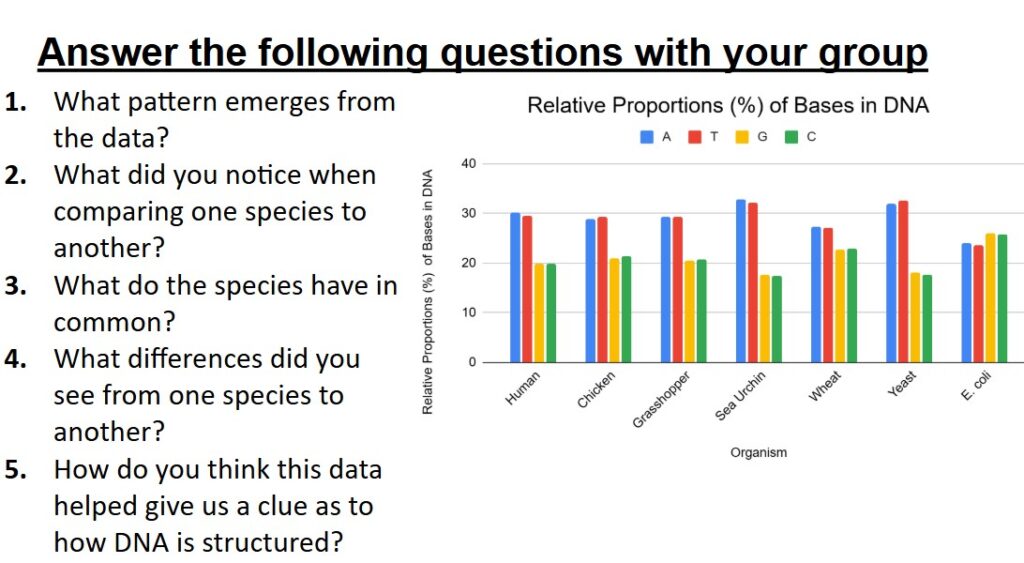
- In small groups, they analyzed a bar graph introducing the idea of Chargaff’s Rule before discussing findings as a class (see below, right).
- From there, I had students take about ten minutes to independently read and annotate an article elaborating on this concept before talking about the newly introduced information as a group.
Feedback reflected growth in leading group discussion. On a positive note, confidence in my ability to lead is developing, shown by feedback from my OU Supervisor stating that my “voice was full of energy and confidence,” noticing that I’m starting to sound “natural and excited, gesturing and expressive when teaching“.
Even though I tried to involve many students and my OU Supervisor pointed out that I’m “getting pretty good volunteer participation,” I still noticed the same repeated students raising their hand and carrying the weight for the rest of the class.
“Student participation is consistent in small groups and slightly less willing for whole class questions-it is coming along though and your questioning skills are improving.” – OU Supervisor
Reflecting on this attempt at leading a group discussion, evidence of success was indicated by the atmosphere of the classroom. According to my OU Supervisor, the class felt “more focused, energetic and fun than I’ve ever seen before!” Students were engaged and motivated to contribute to discussion. A proud moment was when I caught one student high-fiving another for correctly answering and pronouncing the word nucleic, demonstrating the type of supportive classroom community I aim to foster when teaching.